Rebuilding customer acquisition after the channel the business depended on became unreliable.
VEZAR Car Rental had run on Facebook Marketplace for about six years. When that source stopped producing, cars started sitting idle. This is the test we ran to find out whether paid acquisition could replace it, what it cost, and what the data exposed next.
- Client
- VEZAR Car Rental
- Market
- Guildford, Western Sydney
- Channels
- Meta Ads, WhatsApp, Google Business Profile
- Rankees scope
- Paid acquisition, lead journey, local presence
- Engagement
- Test, then ongoing management
Context
A channel that worked for years, and was never really measurable.
VEZAR rents cars out of Guildford in Western Sydney and had been operating for roughly six years before this work began. Almost all of its customers arrived the same way: vehicles listed on Facebook Marketplace across several accounts, the occasional small boost, a Messenger conversation, then a phone number, a phone call, an office visit and a rental.
It was cheap and it worked. It was also fragile. Reach depended entirely on a platform continuing to show the listings, and almost none of it could be measured. Nobody could say how many people saw a listing, how many messaged, or what a customer actually cost to acquire.
Problem
Then the listings stopped producing.
At around the time this engagement started, the Marketplace-led channel became unreliable and inquiries dropped away.
We cannot tell you why. We have no evidence of an algorithm change, a policy enforcement action or any penalty against this business, so we will not claim one. What we can say is what the business experienced: the volume that had arrived for years stopped arriving.
The commercial effect showed up immediately in the yard. The operator reported more than 30 vehicles sitting idle at one point, which was well outside normal for them. Idle cars are the clearest possible cost signal in this business: every one of them is a fixed expense earning nothing.
Diagnosis
We refused to guess, so we turned it into a test.
The honest position at the start was that nobody knew whether paid acquisition would work for this business at a price that made sense. Rental is a considered purchase with licence checks, deposits and availability constraints. So rather than promise an outcome, we framed one question we could actually answer with money and data:
Can Meta Ads become a reliable and measurable customer-acquisition channel for VEZAR?
The test we agreed before any budget was spentAn initial test budget of roughly AUD $1,000 was allocated to answer it. Not to scale anything, and not to hit a revenue target — to find out whether the channel worked and what a customer cost.
What we built
A shorter route from advertisement to rental.
The old journey had four handoffs before anyone spoke to VEZAR, and every one of them lost people. The new one removes the phone number as a gate: the ad opens a WhatsApp conversation directly, an automated first message qualifies the basics, and a person takes over from there.
Meta Ad → WhatsApp → rental
Select any stage to see what happens there and what it was designed to fix.
Meta ad
Paid placements across Facebook and Instagram feeds, stories and reels, optimised for messaging conversations rather than clicks to a website. We tested audiences, vehicles, message angles and creative against each other rather than running one ad and hoping.
WhatsApp opens
Tapping the ad opens a WhatsApp thread with VEZAR already addressed. The old journey asked someone to note a phone number, leave the app and call during business hours. Each of those steps was a place to lose a customer, and WhatsApp is where this audience already is.
Automated first reply
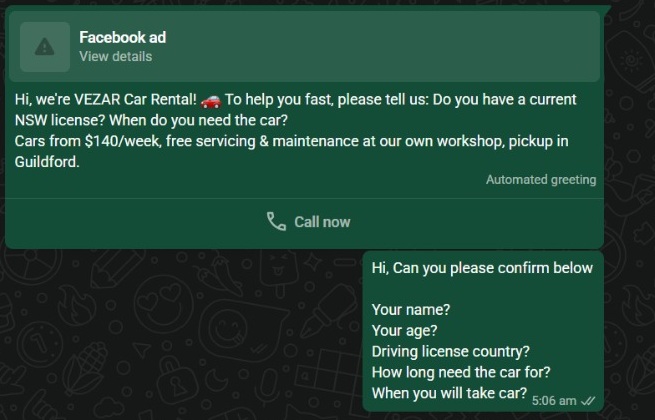
An automated greeting answers within seconds, states the weekly rate and what is included, and asks the two questions that decide whether a rental is even possible: do you hold a current licence, and when do you need the car.
This matters more than it sounds. A reply that arrives in seconds holds attention that a reply arriving an hour later has already lost.
Human takeover
A person at VEZAR picks up the thread and handles the real conversation: which vehicles are free, licence country, rental length, deposit. Rankees does not sell or close on the client's behalf — this stage belongs to their team, and, as the data later showed, it is also where the next constraint turned out to be.
Rental
Licence verification, deposit and handover at the Guildford office. A customer is only counted here — not at the inquiry, and not at a booking that never started.
Evidence
What the test produced.
These five figures belong together. They come from one formal reporting checkpoint covering one spend window, and we have kept them as a set for that reason.
Formal reporting checkpoint
Backend confirmedWhere the money went and what came back
One spend window, read left to right. The percentages under each stage are the conversion from the stage before it.
Read this as a floor, not a ceiling. The booked value uses minimum rental terms only. The bar widths are drawn to make the shape of the funnel readable and are not a linear scale — every figure is printed next to its bar.
Current Meta platform snapshot
Platform reported · 1 Jul–11 Sep 2026This is a wider window than the formal checkpoint above and it counts conversations started, not customers signed. We have not attached a customer or revenue figure to this spend, because no reconciled backend report covering it exists yet.

Result
Three customer counts, three different moments.
The customer total has moved since the formal report, and it would be easy to quietly attach the newest number to the original spend figure. We have not done that. Each milestone below belongs to its own point in time, and the panels say which.
The checkpoint everything else on this page is measured from. 18 paying customers from 235 inquiries, against $882.66 of advertising, giving the $49.04 cost per customer and the ~$11.5k minimum booked value. This is the only figure we attach to that spend.
By the time we wrote the scaling plan, the running total had reached 22. Advertising had continued past the reporting checkpoint, so this total covers more spend than $882.66. We have not reconciled the additional spend against these four extra customers.
The latest count from VEZAR. It is a running total across everything the campaign has done to date, not a result of the original test budget, and it has not been reconciled against a matching spend window.
What we will not say: that $882.66 produced 23 customers. The 22 and 23 totals arrived after the formal report and after further spend. If a future reconciled report shows all 23 in one window, we will update this page and say so.
What the data taught us
Availability was the scalable message.
The insight that changed the campaign
We expected price to lead. Rental is a price-sensitive category and the obvious lever is a lower weekly rate. That is not what happened.
What pulled was immediate availability — telling people the car is ready now and there is no waiting list. At the formal reporting checkpoint, that single angle produced about 43% of all campaign inquiries.
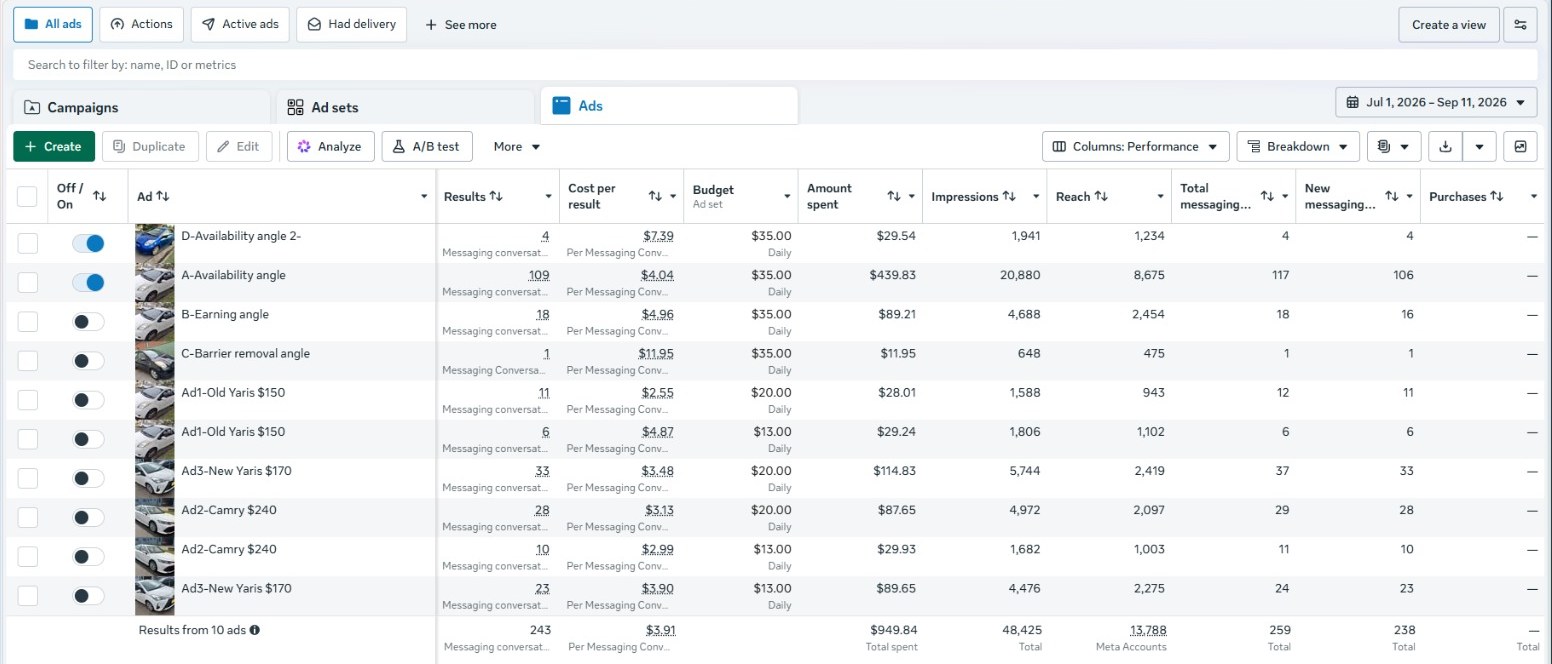
In the later Meta account snapshot the finding held: the primary availability ad still generated 109 of 243 conversation results, keeping availability clearly dominant by volume.
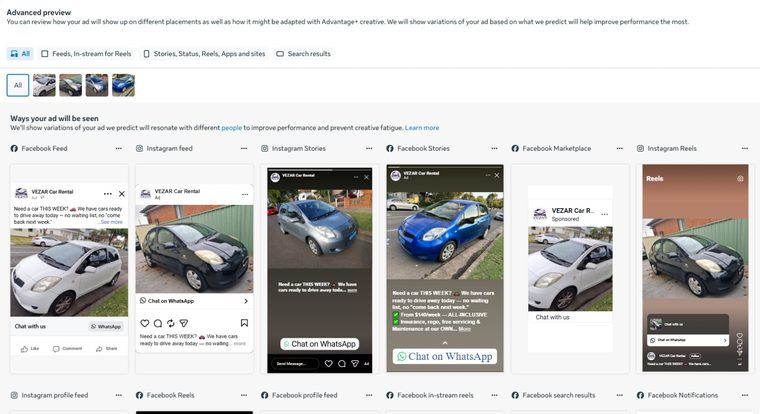
Two lessons, not one winner. First, availability is the scalable customer problem — it is what the market was actually short of, and it carried the volume in both the formal checkpoint and the later snapshot. Second, individual inventory offers are useful tactical creative: some vehicle-specific ads achieved a lower cost per conversation than the availability angle did, but only on much smaller volumes.
Saying one ad simply "won" would flatten that. The availability message is what we scale; the vehicle offers are what we rotate alongside it.
Message angles, later platform snapshot
Platform reportedA capture taken later than the formal checkpoint, covering 1 July to 11 September 2026. Ten ads ran in this window. Message angles and vehicle-specific offers are shown together, because the comparison between them is the point.
Read volume and cost as two different things. The availability angle produced by far the most conversations, at $4.04 each. Several vehicle-specific offers came in cheaper — Old Yaris at $2.55, Camry at $3.13, New Yaris at $3.48 — but on a fraction of the volume. Cheapest is not the same as most scalable, and these ads did not receive equal spend or equal time, so this is a record of a live account rather than a controlled experiment. The barrier-removal angle produced a single result and should be read as untested rather than as a failure.
Audience testing
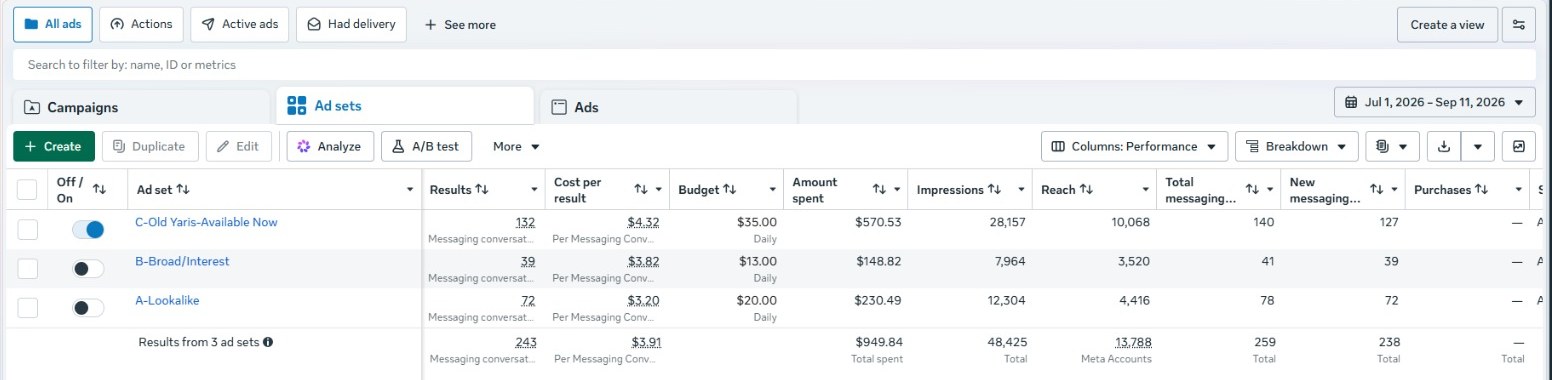
Platform reportedThree audiences ran in the same later window, on different daily budgets. Volume and cost tell different stories, so both are shown.
These were not equal-budget tests, and the spend differed a lot. Available Now ran at $35 a day and took $570.53 of the $949.84; Lookalike took $230.49 and Broad/Interest $148.82. So the volume differences partly just reflect the money behind each ad set.
The fair reading is this: the Lookalike audience produced the lowest cost per conversation in this later snapshot, while the availability-focused ad set produced the largest conversation volume. Neither of those makes one audience the winner — volume, efficiency and spend were all different, and the sensible next move is to give Lookalike more budget and see whether its cost holds as it scales.
Next bottleneck
The ads worked. Then they exposed the next bottleneck.
Answering the original question well created a new problem, and it is the most useful thing on this page. Demand was no longer the constraint. At the formal checkpoint, roughly 8 out of every 100 people who messaged became paying customers. The other 92 did not.
Some were never serious — no licence, wrong timing, price shoppers. But a meaningful share simply went quiet: they messaged, did not get a fast enough reply, or were asked to ring a number and never did. That is not an advertising problem. More budget cannot fix it, and spending more against an 8% conversion rate just buys more of the same leak.
Where it sits today
Out of every 100 WhatsApp inquiries at the formal checkpoint.
8 in 100Inquiries that became paying customers. At $3.76 per inquiry, that is $47 of advertising behind every customer before anything else is counted.
What we are working toward
The improvement target. Not a result — a target we have agreed to work on.
10–12 in 100Moving the same 235 inquiries to this rate would produce roughly 24 to 28 customers instead of 18 — on identical ad spend.
Three changes do most of the work here, and none of them cost media budget. Replying in minutes rather than hours, while the person is still deciding. Answering questions inside WhatsApp instead of asking someone to ring a number. And sending one follow-up message to the inquiries that went quiet, which is most of them.
This is also the point where a case study about advertising stops being about advertising. Demand generation and lead handling are one system; fixing the first without the second just moves the loss further down the line.
Scaling plan
What we expect next, stated as expectations.
Planning ranges for a larger monthly budget
Nothing in this panel has happened. These are the conservative ranges we committed to in the scaling plan, chosen so they can be met or beaten rather than explained away. The cost per customer is expected to rise as spend grows, because the cheapest, most-ready audience is reached first and the market has to be widened after that.
Month 1 · building up
40–50 customers
Budget increased in steps, not all at once, so the platform is not forced to relearn. Full budget is not expected to be deployed this month.
Month 2 · first month at full speed
60–75 customers
Full budget deployed against a wider audience. This is roughly what the budget alone is expected to carry, before any conversion improvement.
Month 3 · getting more efficient
80–95 customers
Signed customers fed back in so the system optimises toward people who actually rent, rather than people who merely message.
On the 100-a-month figure. It is a target, not a promise, and the budget does not get there on its own. At a planning cost of $65–$85 per customer once at full scale, advertising alone lands nearer 70 a month. The remaining 30 come from moving conversion from 8 in 100 toward 10–12. If that does not improve, we expect to sit around 70 and we would rather say so now than explain it later.
Trust layer
People check you before they message you.
A paid ad starts the conversation, but almost nobody hands over a deposit on the strength of an advertisement alone. Between seeing the ad and committing, a fair share of people search the business name, read the Google profile, look at the reviews and glance at the website. If any of that is missing or looks abandoned, the inquiry quietly does not happen — and it never appears in the ad account as a loss.
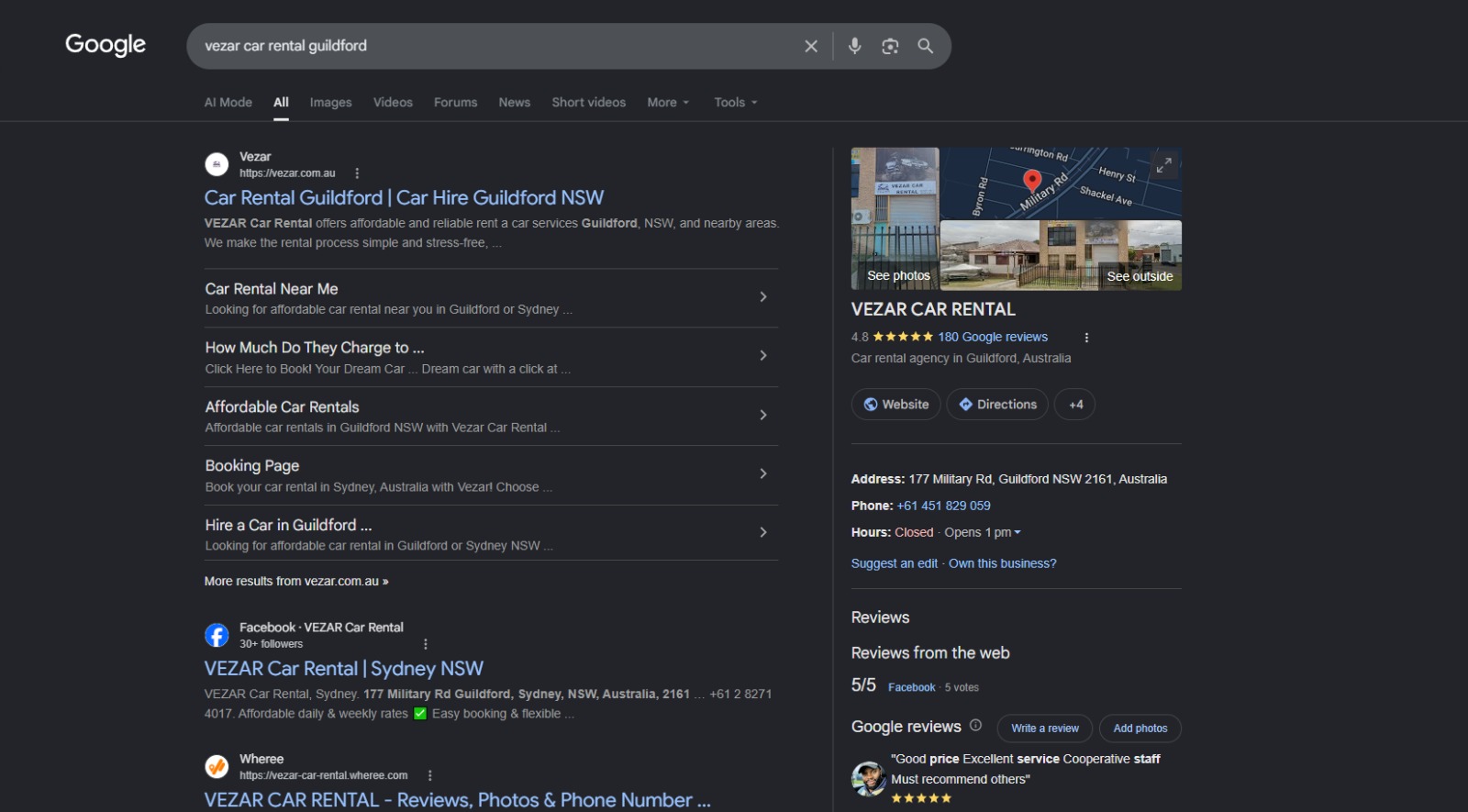
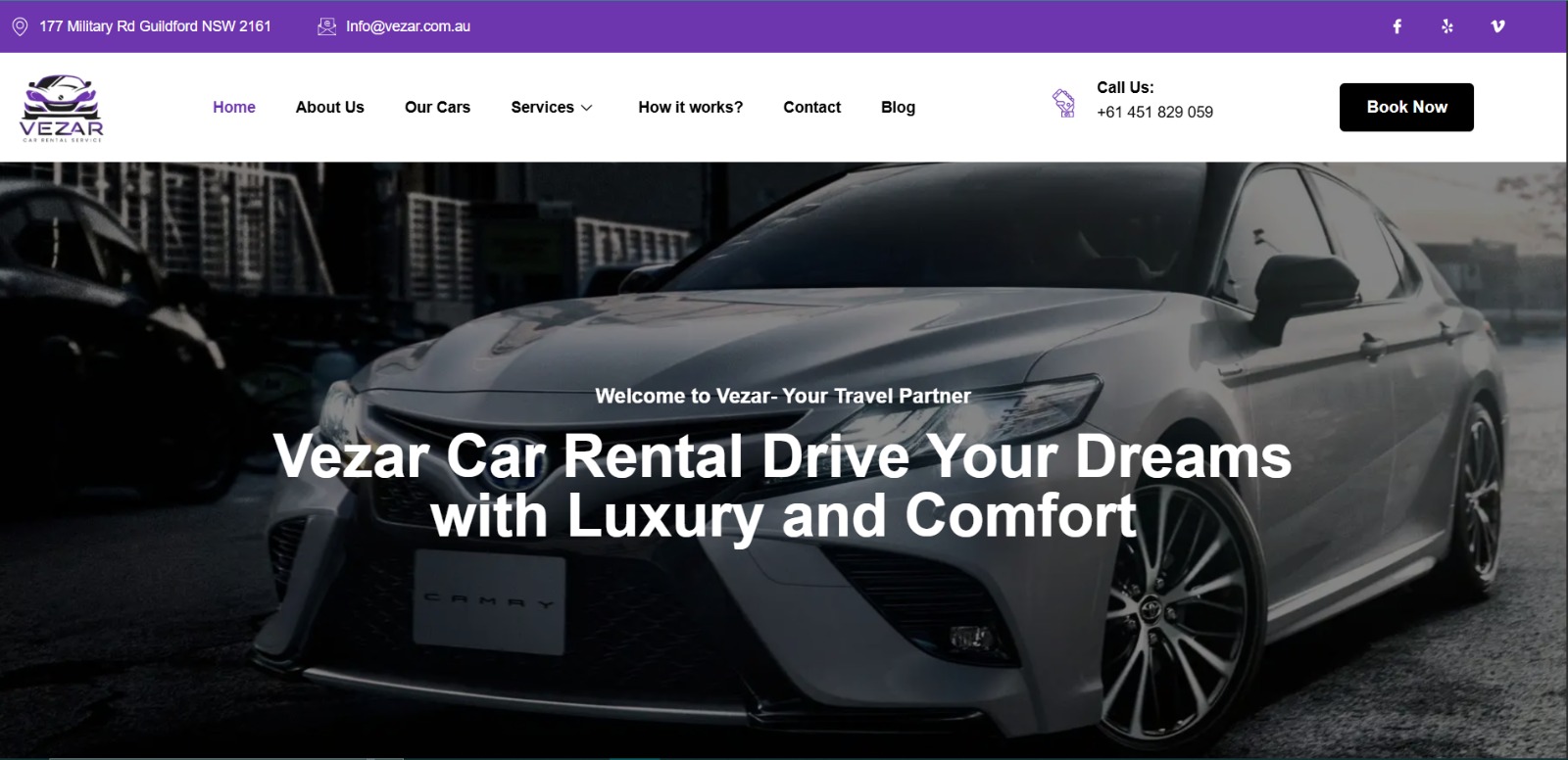
We did not create these 180 reviews, and we are not claiming them. They are the result of six years of the business renting cars to people who were happy enough to say so. What this screenshot proves is the trust layer a paid ad is landing on today — and that is the thing worth protecting as spend increases.
Evidence vault
The receipts, if you want to check the story.
Everything above is explained in plain language so it can be understood without reading a dashboard. These are the original captures behind it. Each one names its source, the window it covers and what it actually proves. Select any card to open it full size.
How to read the labels on this page
Checked against the client's own records rather than a platform's reporting.
Taken from Meta Ads Manager. Useful for direction, but it counts conversations started, not customers signed.
A publicly visible profile or page as it stands today. It proves the present state, not who produced it.
Supplied by the business and not yet reconciled against a platform export.
A forward-looking planning range. Never a result.
Work is continuing and the figures here will change.
More work
Other published case studies.
Kadbanou
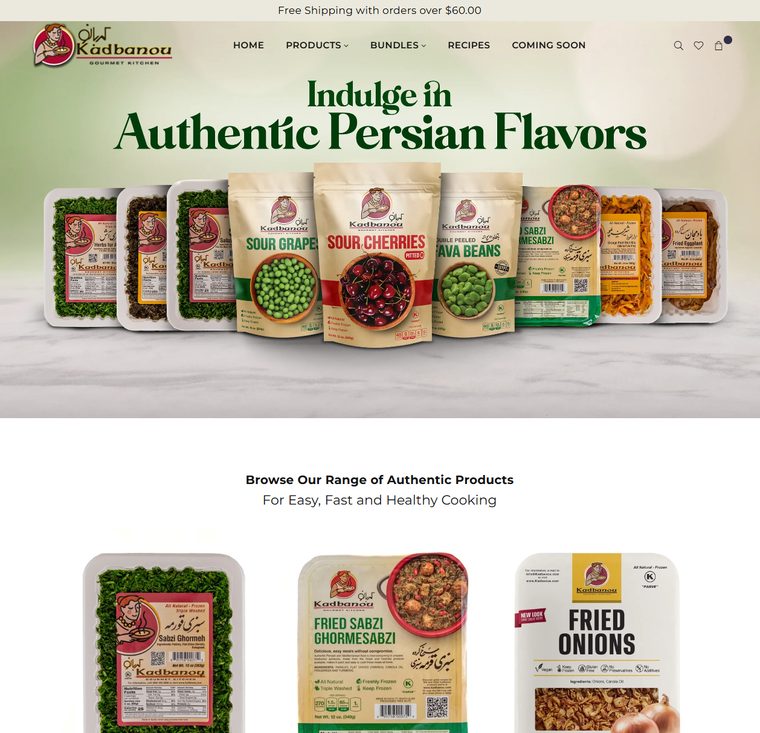
Storefront first, ads second. Meta attributes 15 purchases, Shopify documents 14 paid orders, and we publish both rather than forcing them to agree.
Read the case study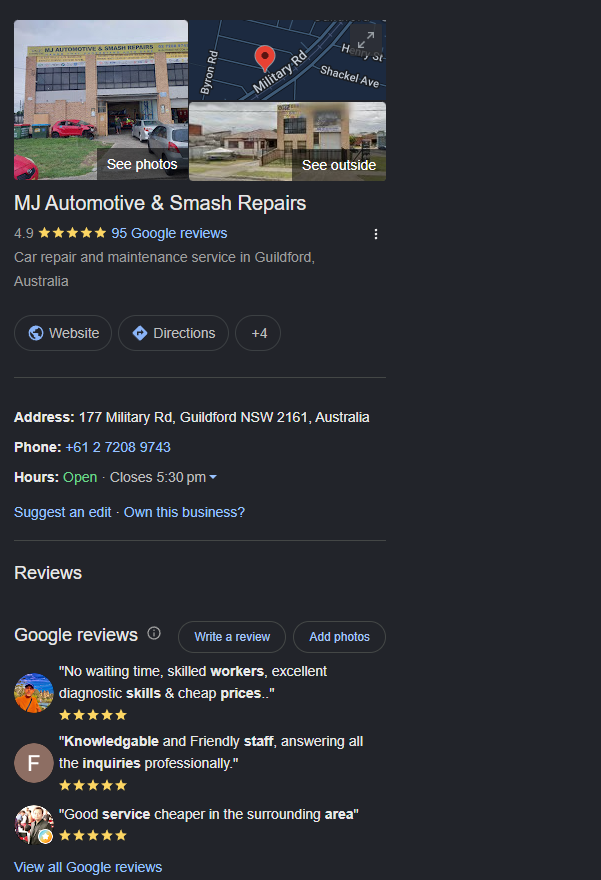
MJ Automotive & Smash Repairs
Making a working repair shop easy to find, verify and call. Ongoing, and measured honestly.
Read the case studyHave a similar acquisition bottleneck?
Ads solved the demand question for VEZAR and then showed where the real loss was. If you are spending on advertising and cannot say what a customer costs, or you can and the number does not work, that is the conversation to have.